
Language exchange works because real conversations with real people beat any textbook. But AI has become a brilliant sidekick for tandem learners — it can break the ice, keep sessions fun, explain the words your partner uses, and even stand in when they're not around. Here are five ways we use AI at Linguar, with example prompts you can copy straight into your next session.
1. Suggest Topics to Talk About
Finding conversation topics with a new tandem partner can be challenging, especially when you're just starting out with a language. You'll quickly exhaust the basics like talking about where you're from or what you do for work. This is where AI really shines — it can generate creative conversation ideas that match your current proficiency level.
We often provide some basic information about both participants to help AI suggest more relevant topics. You can customise this quite a bit, and it's particularly helpful to ask for key vocabulary in your target language that you can use as conversation starters for each topic. This way, you're not just getting topic ideas, but also building your vocabulary around themes you'll actually discuss.
Try this prompt:
My tandem partner and I are doing a Spanish–English exchange. I'm A2 in Spanish and love hiking and cooking; she's B1 in English and into photography. Suggest 5 conversation topics we can both manage, and for each topic give me 6–8 key Spanish words or phrases with English translations to use as conversation starters.
2. Come Up with Games and Challenges
This is one of our favourite uses of AI, since it can come up with really fun and creative games to make the tandem session more fun and intriguing. Here are some examples that we're using:
- Five-word sentences: Get 5 commonly used words and ask your partner to make a sentence out of them. If some words are new, try to explain the meaning in the target language.
- Collaborative storytelling: Generate a story prompt in German, then take turns adding one sentence at a time. Scavenger hunts for specific phrases work well too.
- Role-play with a twist: Have AI generate unusual situations like "You're both astronauts who've just discovered a café on Mars" or "You're time travellers trying to order food in medieval times." Practising conversations while staying in character makes vocabulary practice feel more natural and memorable.

- Translation telephone: Start with a simple sentence in one language, have your partner translate it to their native language, then translate it back. Compare the final result with the original — the funny mistranslations often reveal interesting cultural nuances and grammar patterns you might not notice otherwise.
- Word association storytelling: AI gives you a random word (like "umbrella" or "Tuesday"), and you take turns building a story one sentence at a time, but every sentence must somehow connect to that original word. This pushes you to use creative vocabulary and helps with spontaneous speaking skills.
Try this prompt:
Invent 3 quick games for a 30-minute French–English tandem session. One of us is B1 French, the other is A2 English. Each game should take about 10 minutes, need no materials, and get both of us speaking equally. Explain the rules in 2–3 sentences each.
3. Explaining Words and Phrases
AI is great at understanding and speaking a broad array of different languages. Here at Linguar we have integrated this into our messaging application, to make it easy for you to understand and learn new words and phrases. By default, the translation is in English, but you can configure this to, for example, your native tongue.
What makes AI particularly valuable for language exchange is its ability to provide context-rich explanations that go beyond simple translations. When you encounter an unfamiliar word or phrase, AI can break down not just what it means, but how it's used in different situations. For instance, if you're learning Spanish and come across "quedar," AI can explain that it means "to stay" in some contexts, "to meet up" in others, and "to fit/suit" when talking about clothes — something a basic dictionary might not capture as clearly.
AI can also help with cultural nuances and colloquialisms that often confuse language learners. It can explain why certain phrases are formal versus casual, regional variations in usage, or even the cultural context behind expressions. This is especially helpful when your language partner uses slang or idioms that don't translate directly.
Try this prompt:
My tandem partner (from Mexico) just wrote "¡Qué padre!" in our chat. Explain what it means, whether it's formal or casual, where it's used regionally, and give me 3 example sentences showing how I could use it naturally.
4. Build Your Personal Vocabulary
The words that matter most are the ones that come up in your own conversations — and AI makes it easy to capture them before they slip away. On Linguar, any translation or explanation in the chat can be added to your flashcard trainer with a quick dropdown selection, so you can save new vocabulary in the moment without interrupting the conversation flow.
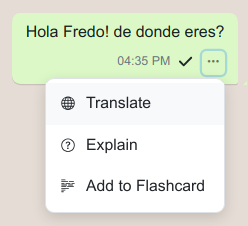
The vocabulary trainer uses spaced repetition, similar to Anki and Mnemosyne, so the words resurface right when you're about to forget them. It also supports audio and images — you can simply highlight a segment in chat and add it directly to a collection, then review it later.
You can take this further with AI: paste in a list of words you've collected and ask for a quiz, a cloze exercise, or fresh example sentences to test yourself before your next session.
Try this prompt:
Here are 10 German words I saved from my last tandem session: [paste your words]. Quiz me one word at a time — show me an example sentence with the word blanked out, let me guess, then tell me if I'm right and give a memory hook for any I miss.
5. Simulated Practice Partners
When your tandem partner isn't available, large language models can simulate conversations with native speakers. They can role-play in your target language, adjust to your proficiency level, and provide feedback on your responses.
This is particularly valuable for building confidence before real conversations. AI can simulate specific scenarios you might encounter, like ordering food at a restaurant, asking for directions, or having a job interview. You can practise the same conversation multiple times without feeling embarrassed about making mistakes or asking for repetition.
What makes AI especially useful as a practice partner is its patience and consistency. It won't get frustrated if you need to repeat a phrase several times, and it can provide immediate corrections and explanations. You can also ask it to slow down, speed up, or use more formal/informal language depending on what you want to practise.
AI can also role-play as different types of people — a friendly shopkeeper, a formal business colleague, or a casual friend — helping you understand how language changes based on social context. This variety of practice scenarios helps prepare you for the unpredictability of real-world conversations.
Try this prompt:
Role-play as a waiter in a Lisbon café. Speak only Portuguese, keep your sentences short and simple (I'm A2), and stay in character while I order. After we finish, break character and give me feedback: correct my mistakes and suggest more natural phrasings.
Make Your Next Exchange Better
AI won't replace your tandem partner — the awkward pauses, the laughter at mistranslations, and the cultural stories are what make language exchange work. But used well, it removes the friction: no more blank-page moments, unexplained slang, or lost vocabulary.
Pick one of the prompts above and try it in your next session. And if you don't have a tandem partner yet, Linguar will match you with someone learning your language — with AI translation, explanations, and a vocabulary trainer built right into the chat.
